Coupled Oscillator: Hellie

From Class Wiki
Jump to navigation Jump to search

Problem Statement

Write up on the Wiki a solution of a coupled oscillator problem like the coupled pendulum. Use State Space methods. Describe the eigenmodes of the system.
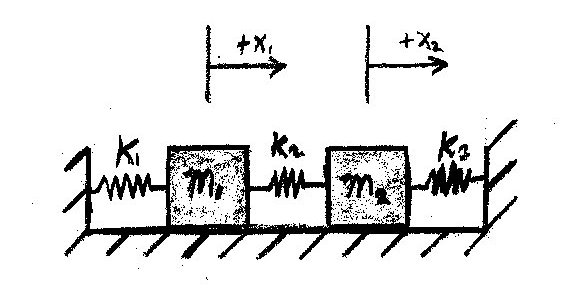
 

Initial Conditions:

m1=10kg
m2=10kg
k1=100N/m
k2=150N/m
k3=100N/m

State Equations

[x1˙x1¨x2˙x2¨] = [0100(k1−k2)m10−k1m100001−k1m20(k1+k2)m20][x1x˙1x2x˙2]+[0000000000000000][0000]

With the numbers...


[x1˙x1¨x2˙x2¨] = [0100(−50N/m)10kg0−100N/m10kg00001−100N/m10kg0(250N/m)10kg0][x1x˙1x2x˙2]


[x1˙x1¨x2˙x2¨] = [0100−50−1000001−100250][x1x˙1x2x˙2]


Eigenvalues

λ1=−5.29412

λ2=2.83333i

λ3=−2.83333i

λ4=0


Eigenvectors

k1=[−.05379.28475.17764−.94046]


k2=[−.31854i.90253−.09645i.27326]


k3=[.31854i.90253.09645i.27326]


k4=[−.05379−.28475.17764.94046]


Eigenmodes

There are two eigenmodes for the system
1) m1 and m2 oscillating together
2) m1 and m2 oscillating at exactly a half period difference


Solve Using the Matrix Exponential


eAt=ℒ−1{[SI−A]−1}


[SI−A] = [S100(−50N/m)15kgS−100N/m15kg000S1100N/m15kg0(250N/m)15kgS]


[SI−A]−1=


ℒ−1{[SI−A]−1}=


Written by: Andrew Hellie